Borj Nord (Burj al
Borj Nord (Burj al
A 16th-century Saadian fortress overlooking Fès, Borj Nord houses Morocco's National Arms Museum and offers sweeping views across the medina.
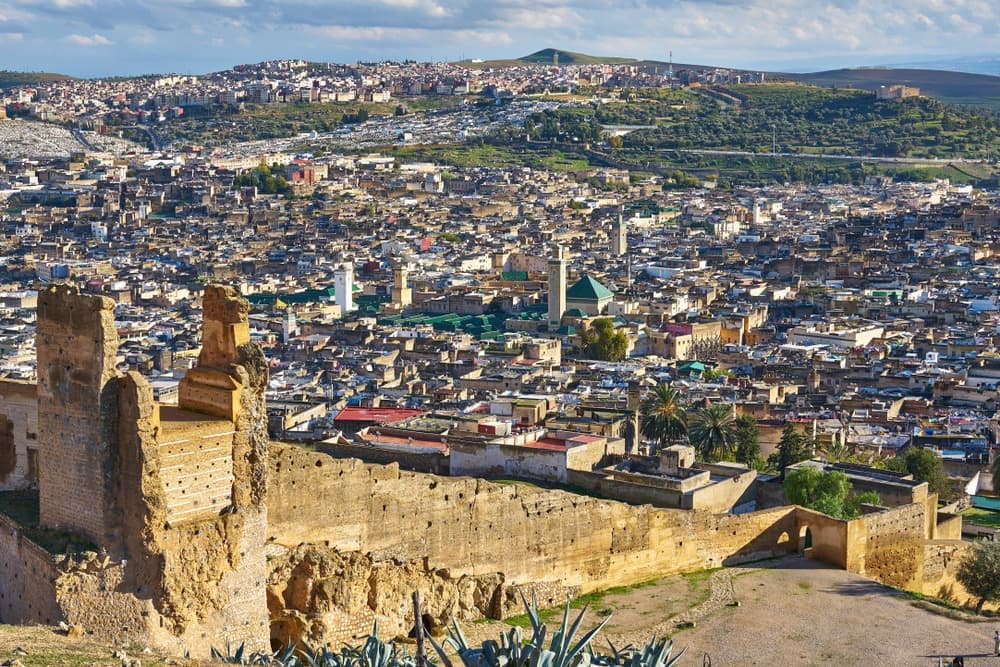
Borj Nord rises above the medina of Fès from a hilltop on the city's northern edge. This former Saadian fortress from the 16th century now houses the National Arms Museum of Morocco, whose collection encompasses over one thousand pieces spread across fifteen galleries. From its crenellated roof, the panorama sweeps across the entirety of Fès el-Bali.
Why Visit Borj Nord
Three reasons merit a detour to this fortress. First, the Saadian military architecture itself—a rare testament to 16th-century Moroccan defensive urbanism. Next, an extensive arms collection spanning from prehistory to the 20th century, featuring pieces from Morocco, Europe, the Middle East, and Asia. Finally, the vantage point over Fès medina, particularly striking in late afternoon when raking light sculpts the terraces and minarets.
History
Borj Nord was erected by Saadian sultan Ahmad al-Mansour in 1582. The Saadians sought to intimidate Fès's population, known for its unruliness, and to deter invasions from the north. Several fortresses were thus positioned on the heights commanding the old city, equipped with cannons capable of bombarding the medina should revolt break out.
Beyond Borj Nord, the defensive complex included Borj Sud, the Kasbah Tamdert citadel to the southeast, and the bastions of Fès el-Jdid. All were built in a style inspired by Portuguese military architecture. Tradition holds that European prisoners captured at the Battle of Three Kings in 1578 may have participated in the construction.
From above, Borj Nord today assumes a star shape. Scholars believe corner bastions were added during the Alaouite period, the original structure having had a more compact, cubical silhouette comparable to Borj Sud, which retained its initial form.
During the French Protectorate, the fortress served successively as a barracks and then a prison. In 1963, the Moroccan government transferred the arms collection from the Batha Museum in Fès to this site, establishing Morocco's National Arms Museum.
What to See at Borj Nord
The exhibition unfolds across fifteen thematic galleries, from prehistoric weaponry to contemporary arms.
The Museum Collection
Upon entry, two rifles and two sabres from southern Morocco open the journey. The first gallery is devoted to prehistoric hunters' weapons. The second assembles bladed weapons and sabres from Algeria, China, Turkey, Italy, and Spain. Of note is an Indonesian dagger from the Mataram dynasty (17th century).
Subsequent galleries alternate between military artifacts (Iranian bracers and shields, Polish helmets), archival photographs of fortifications, and wheel-lock and flint-lock mechanisms. Gallery 5 preserves an explosive device from the late 19th century discovered at Fès's Makina. Gallery 6 displays a French machine gun from the First World War and a Belgian sub-machine gun manufactured in 1871 in Brussels.
Galleries 7 to 10 feature carbines, rifles, revolvers, automatic pistols, hunting equipment (crossbows, traps, slings, lances), and Moroccan and European cannons accompanied by their projectiles and cleaning apparatus.
Galleries 11, 12, and 13 bring together rifles from southern and northern Morocco, including pieces used at the Battle of Oued El Makhazine in 1578, complemented by rural and urban sabres. Gallery 14 showcases Moroccan horse saddles from the 19th century. The final gallery focuses on intricately decorated 19th-century daggers.
At the museum's exit stands a 16th-century Moroccan bronze cannon known as "Sidi Mimoun", considered the site's most striking artifact.
The Panorama over Fès
The crenellated roof affords an unobstructed view across the medina, surrounding hills, and on clear days, to the foothills of the Middle Atlas. Photography is prohibited inside the museum but permitted from the terrace.
When to Visit
The site welcomes visitors year-round. Spring (March–May) and autumn (September–November) offer pleasant temperatures and crisp light, ideal for photography. Summer remains feasible but heat can be intense midday.
To make the most of the panorama, favor late afternoon, when golden light bathes Fès el-Bali's terraces. This is also when the medina's hues appear most vividly from the terrace.
Practical Information
- Closure days: the museum typically closes one day weekly; verify locally before visiting.
- Hours: open morning and afternoon with midday break; confirm on site.
- Admission: modest entry fee.
- Duration: allow 1 to 1.5 hours to tour the exhibition and enjoy the panorama.
- Photography: prohibited in galleries, permitted from the crenellated roof.
How to Get There
From Fès medina, allow about thirty minutes on foot via lanes ascending the northern hill. The walk is manageable but steep; a petit taxi avoids the climb if preferred.
Fès is served by an international airport with connections to several European cities, notably France and Belgium. Train service links the city to Marrakech in approximately seven hours, and to Casablanca, Rabat, or Tangier in a few hours via the ONCF network.
Nearby Attractions
Several sites merit an extended visit:
- The Medersa Bou Inania, roughly 600 m away, for its sculptural stucco and Marinid architecture.
- The Bab Boujloud Gate, the monumental entrance to Fès el-Bali.
- Borj Sud, situated opposite across the valley, retaining its original cubic form.
To further explore Moroccan defensive and religious architecture, consult our guides to the Fort Bou Jerif, the Palais de Bahia in Marrakech, or the Ben Youssef Medersa.
Frequently Asked Questions
Frequently asked questions
Allow 1 to 1.5 hours to tour the fifteen museum galleries and enjoy the panorama from the crenellated roof.
It is prohibited inside the exhibition galleries but permitted from the crenellated roof, which offers the finest view of the medina.
Late afternoon is recommended for golden light over the medina from the terrace. Morning also suits those seeking to avoid summer heat.
On foot, allow roughly 30 minutes via lanes ascending the northern hill. A petit taxi lets you bypass the climb.
No, admission is on-site without reservation. Entry costs a modest fee.
Plan Your Journey
Borj Nord fits naturally into a thorough exploration of Fès and its fortifications. To craft an itinerary combining the imperial cities, medinas, and Moroccan defensive architecture, see our Morocco travel packages.
Interested in this visit?
We can include it in your personalised itinerary.