Kasbah Telouet or Glaoui Palace
Kasbah Telouet or Glaoui Palace
Formerly the Glaoui's residence at 1,650 meters in the High Atlas, Kasbah Telouet preserves refined period decorations from 1942, frozen in time since its looting in 1956.
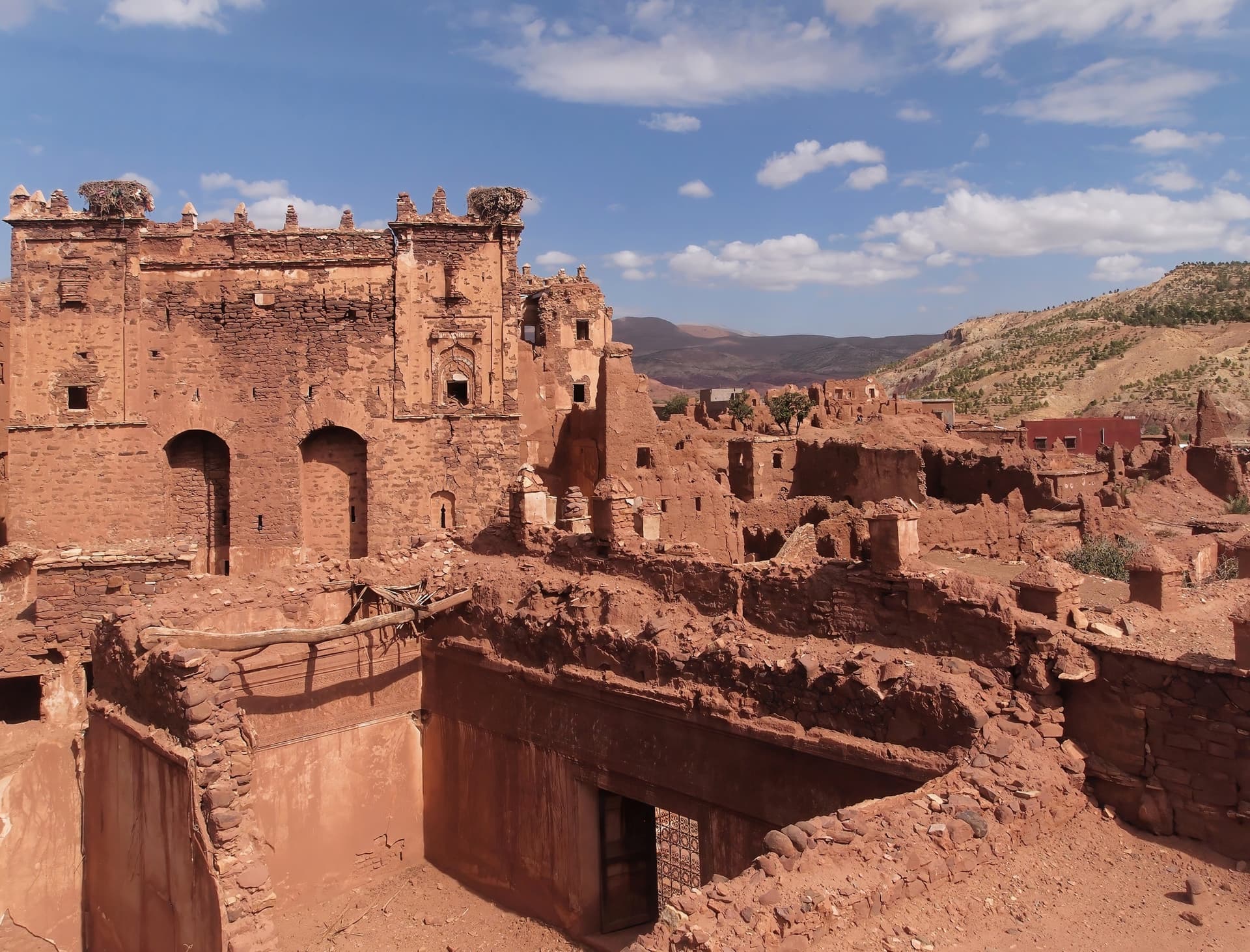
Kasbah Telouet stands at 1,650 meters altitude in the High Atlas, between Marrakech and Ouarzazate. Once the residence of the Glaoui, pachas of Marrakech, this vast fortified complex bears witness to local power that faded in the mid-twentieth century. Abandoned since 1956, the kasbah has undergone no restoration, lending it a raw atmosphere somewhere between palace and ruin.
Why visit Kasbah Telouet
Kasbah Telouet holds both architectural and historical interest. Inside, rooms adorned with finely carved stucco, zellige tilework, painted cedar ceilings, and Italian marble testify to the splendor achieved by the Glaoui during the first half of the twentieth century. Outside, the highly uneven state of preservation—some rooms intact, others collapsed—provides direct insight into the brutal decline of this dynasty following Morocco's independence.
The site lends itself well to a combined visit with the crossing of the Tichka Pass and the Ounila valley, on the route connecting Marrakech to Ouarzazate.
History of the kasbah
The Telouet site already sheltered an ancient kasbah, dating from the eighteenth century, whose ruins still neighbor the main building. Construction of the current kasbah dates to 1860. It was built beside the earlier structure, at a strategic location commanding the caravan route linking Marrakech to the Sahara, near the region's rock salt deposits.
The kasbah reached its definitive scale under Thami El Glaoui, pasha of Marrakech from 1912 to 1956. In 1938, historian Henri Terrasse described it as a "grand seigniorial ksar," a phrase summarizing the clan's political weight at that time. In 1942, Thami El Glaoui ordered major works employing 300 laborers, producing most of the decorations visible today.
His proximity to French colonial power turned against him as the national movement gained strength. Upon his death in 1956, his eldest son Si Brahim became caid of Telouet, but had left Morocco a year earlier to settle in France. In July 1956, the kasbah was stormed by 300 men of the National Liberation Army, then looted. It has undergone no restoration work since.
What to see on site
The complex originally formed an ensemble combining a fortress, a palace, and a caravanserai, in a Amazigh style enriched with Oriental and Hispano-Moorish influences. Today, only the main residence and a few annexes are sufficiently preserved to be explored.
The state rooms
The rooms open to visitors concentrate the decorations commissioned in 1942:
- painted cedar ceilings, geometric and floral motifs;
- finely carved stucco panels on the upper sections of walls;
- zellige and mosaics covering the base of the walls;
- Italian marble floors in the main rooms.
Technical elements and terrace
The visit also allows observation of the heating system via ducts integrated into the walls, a rare testament to domestic comfort in a mountain kasbah. The terrace offers views of the ruins of the ancient kasbah and the villages of the valley.
Practical information
- Duration of visit: allow 45 minutes to 1.5 hours depending on your interest in the decorations.
- Entrance fee: modest rate, collected on-site by the keeper at the entrance. Bring cash in dirhams.
- Guide: a local guide is generally available on-site. His presence is useful for identifying rooms and contextualizing the history of the Glaoui.
- Comfort: few tourist amenities, uneven floors, narrow staircases. Closed-toe shoes recommended.
When to visit
The site is accessible year-round, but altitude (1,650 m) and passage through the Tichka Pass (2,260 m) influence road conditions.
- April to June and September to October: the most comfortable periods, moderate temperatures and favorable light for photography.
- July-August: heat is manageable at altitude, but the interior of the kasbah remains cool.
- December to March: visits possible, but the Tichka Pass may be slowed by snow or ice. Check road conditions before departing.
How to get there
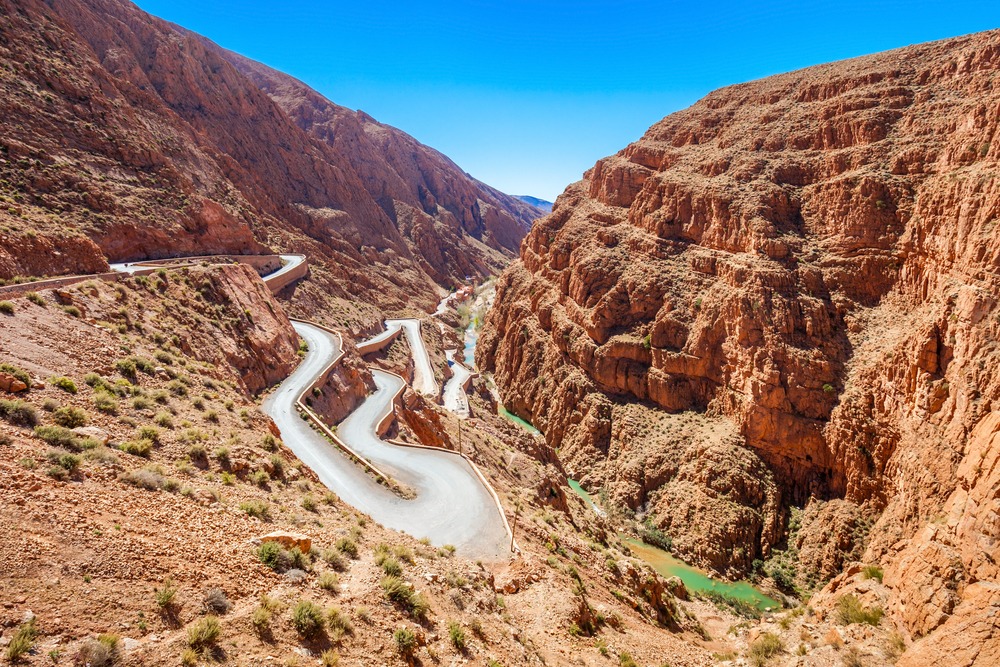
The kasbah is located near the village of Telouet, approximately 140 km from Marrakech. The most common route follows the national road Marrakech-Ouarzazate (N9) beyond the Tichka Pass, then a secondary road that reaches Telouet via the valley.
The journey from Marrakech takes 3 to 3.5 hours by car due to the terrain. No regular public transport links directly serve the kasbah; main options are car rental, privately hired taxi for the day, or an organized excursion combining Telouet and Aït-Ben-Haddou.
Nearby attractions
The region lends itself well to an itinerary of two to three days:
- Aït-Ben-Haddou: UNESCO-listed ksar, approximately one hour's drive via the Ounila valley;
- Ouarzazate: stopover town with film studios and Taourirt kasbah;
- Ounila valley: scenic route between Telouet and Aït-Ben-Haddou, punctuated by Berber villages.
To further explore Moroccan historical architecture, you may also consult the Ben Youssef Medersa and the Bahia Palace in Marrakech, or the Bou Jerif Fort in the south of the country.
Frequently asked questions
Frequently asked questions
Yes, but the day is packed: expect 6 to 7 hours of driving round-trip, leaving little room to combine Telouet with Aït-Ben-Haddou. An overnight stay in Ouarzazate or in the Ounila valley is more comfortable.
No. Since its looting in July 1956, no restoration work has been undertaken. The decorated rooms are preserved as-is, which explains the stark contrast between intact rooms and collapsed areas.
A dynasty of High Atlas notables who became highly influential under the French protectorate. Thami El Glaoui, pasha of Marrakech from 1912 to 1956, was its dominant figure. His alignment with France discredited him following Morocco's independence.
It is not mandatory, but recommended. Signage on-site is limited and a local guide provides the historical context necessary to understand the organization of the complex.
The N9 is paved and well-marked, but the Tichka Pass features many hairpin turns. In winter, snow may slow or block traffic. Check conditions before departing.
Plan your trip
Kasbah Telouet fits naturally into a circuit connecting Marrakech, the High Atlas, and the Drâa valley. To build a customized itinerary including this stop, consult our suggestions for travel in Morocco.
Interested in this visit?
We can include it in your personalised itinerary.