Dar Batha Museum
Dar Batha Museum
A former royal palace turned Museum of Islamic Arts, Dar Batha preserves 6,500 artworks in Fès, an Arabo-Andalusian garden and remarkable zellige decorations.
Housed in a former palace dating from the late 19th century west of the Fès medina, Dar Batha Museum holds a collection of 6,500 historical and archaeological artworks related to Moroccan and Islamic heritage. Reopened in 2019 following a major renovation under the name Museum of Islamic Arts, it combines palatial architecture, an Arabo-Andalusian garden and a thematic journey through Fassi craftsmanship.
Why visit Dar Batha Museum
- A reference collection on Islamic arts and Fès craftsmanship, featuring rare pieces such as the 14th-century minbar from the Bou Inania madrasa.
- A richly decorated Hispano-Moorish palace: colourful zellige tilework, brick horseshoe arches, painted wooden ceilings.
- An Arabo-Andalusian garden covering nearly 58% of the palace grounds, designed in 1915 by landscape architect Jean-Claude Nicolas Forestier.
- An ideal location just steps from Bab Bou Jeloud, the prime entrance to the medina.
History of Dar Batha Palace
Before becoming a museum, the site occupied a strategic position between the two historic cores of the city. Under Sultan Moulay Hassan I (late 19th century), walls were erected to connect Fès el-Bali and Fès el-Jdid, creating a complex of gardens and royal palaces. The Ben Jelloun family of Fès acquired the land before it received a royal palatial purpose.
Moulay Hassan I intended Dar Batha as a summer palace and reception venue for distinguished guests. His successor Moulay Abdelaziz continued construction between 1886 and 1907. The neighboring palace, Dar el-Beida, was completed under Sultan Abdelhafid's reign. In 1912, both buildings became the residence of the French Resident-General of the protectorate.
In 1915, Dar Batha was transformed into a museum of local arts. It achieved the status of national monument in 1924. More recently, a 15.6-million-dirham renovation completed in 2019 enabled its reopening under the name Museum of Islamic Arts, with a redesigned museum layout.
What to see at Dar Batha Museum
Palace architecture
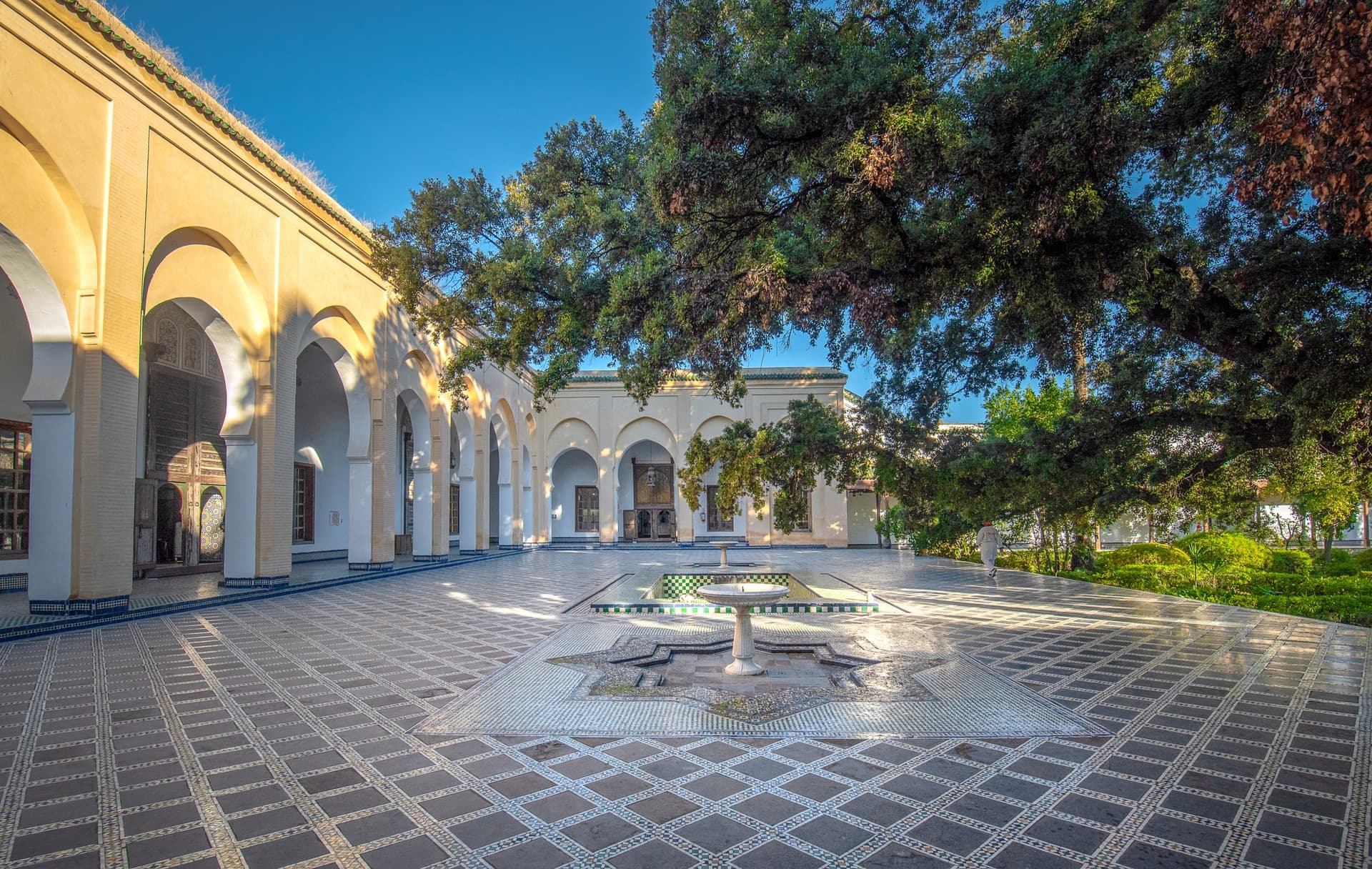
The central courtyard is bordered by galleries extending on all four sides. The east and west galleries rest on large brick horseshoe arches, while the north and south galleries feature painted wooden structures. Floors and fountains are enhanced with colourful zellige tilework characteristic of Fassi art. Other rooms in the palace retain original painted woodwork and wall decorations.
A collection of 6,500 pieces
The museum brings together artworks and archaeological objects spanning several centuries of Moroccan and Islamic history:
- Architectural fragments from the Idrisid era (8th–10th century).
- Remains of the 9th-century minbar from the Andalusian Mosque.
- 14th-century minbar from the Bou Inania madrasa.
- Ancient Qurans, astrolabes, musical instruments, carpets and jewellery.
- Fès ceramics, notably the famous Fès blue style.
West Wing: State Apartments
The West Wing houses the state apartments and several thematic rooms devoted to religious and scholarly life, Fassi craftsmanship, metalwork (kitchen, lighting, equestrian equipment) as well as rural arts from the Pre-Rif and Middle Atlas regions — traditional clothing and woven carpets.
East Wing: Ceramics and Pottery
The East Wing displays approximately 150 ceramic pieces. The first rooms focus on glazed Fès ceramics and Fès blue. Room 5 highlights pottery crafted by women from the Tsoul, Sless and Beni Zeroual tribes, testifying to rural craftsmanship passed down through generations.
The Arabo-Andalusian Garden
The garden covers nearly 58% of the palace grounds. Designed in 1915 by Jean-Claude Nicolas Forestier, it follows a rectangular layout divided into four sections around a central fountain, in the tradition of Andalusian gardens. Palms, hibiscus, jacarandas, holm oak, mimosa and rosemary create a Mediterranean atmosphere ideal for rest between exhibition rooms.
Practical information
- Address: 5, Place Batha Oued Fejjaline, Fès.
- Recommended visit duration: allow 1 to 2 hours to explore the wings and garden.
- Admission fee: moderate entrance fee, payable on-site. Rates may change: check with the museum before your visit.
- Opening hours: open year-round except public holidays. Consult official hours the day before your visit.
- Good to know: the zellige tilework, painted ceilings and garden are particularly suited to photography in soft morning light.
How to get to the museum
The museum is located west of the Fès medina, on Place Batha, a few minutes' walk from the Blue Gate (Bab Bou Jeloud), the main entrance to Fès el-Bali.
On foot from the medina
From Bab Bou Jeloud, allow approximately 5 minutes' walk. This is the simplest option if you're staying in a riad within the medina.
By taxi
Fès's small red taxis serve Place Batha from the new town and the railway station. Ask for the meter or agree on the fare before boarding.
By car
If you're arriving in a rental car, parking is available around the medina, near Bab Bou Jeloud and Bab Boujat. Since traffic is impossible inside the medina, outdoor parking remains standard.
What to see nearby
The museum's location makes it an excellent starting point for exploring the Fès medina:
- The Bou Inania madrasa, a Merinid masterpiece of the 14th century, whose minbar is preserved at Dar Batha.
- Bab Bou Jeloud and the adjoining souk, just steps away.
- The souks and caravanserais of Fès el-Bali, a UNESCO World Heritage site.
- To further explore Moroccan madrasas, the Ben Youssef madrasa in Marrakech offers an interesting architectural parallel.
- In Marrakech as well, the Bahia Palace illustrates Moroccan palatial art from the same period.
Frequently asked questions
Frequently asked questions
Plan your trip to Fès
Dar Batha Museum naturally fits into a stay devoted to Fès and its heritage. To build a tailor-made itinerary incorporating imperial medinas, craftsmanship and grand landscapes, explore our Morocco travel ideas.
Interested in this visit?
We can include it in your personalised itinerary.