Devil's Hole
Devil's Hole
On the Atlantic coast of southern Maroc, near Akhfenir, Devil's Hole is a marine chasm formed by the collapse of a limestone cave. Free access.
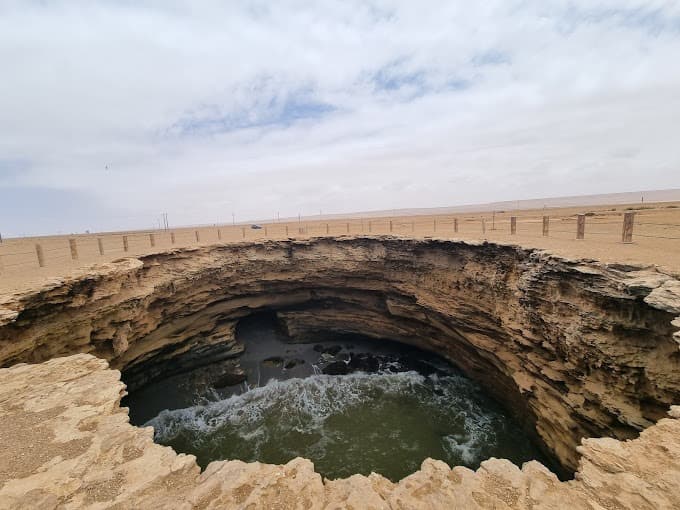
On the Atlantic coast of southern Maroc, approximately 100 km north of Tarfaya and in the immediate vicinity of the village of Akhfenir, Devil's Hole forms a gaping cavity opening onto the ocean. Also known as the Akhfenir Chasm, this geological site of approximately 30 meters in diameter marks the limestone coastline of the Tarfaya region, on Route N1 connecting Guelmim to Laâyoune.
Why visit Devil's Hole
Devil's Hole appeals to geology enthusiasts, travelers heading toward the Atlantic Sahara, and photographers alike. The site dramatically illustrates marine erosion on a limestone coast: a cave carved by the sea whose ceiling has partially collapsed, leaving behind a natural arch. When the swell rushes under the arch and the offshore wind sweeps through the cavity, the chasm produces a deep, powerful sound that carries far across the plateau.
The stop is brief but striking: it breaks the monotony of the long coastal road between Tan-Tan and Tarfaya, and offers a natural free rest point accessible to all types of travelers.
What to see on site
A geological formation typical of the southern Atlantic coast
The chasm is the result of wave action that carved the coastline, composed of limestone rock, over thousands of years. The cave thus formed has collapsed, creating this chasm open to the sky. Part of the ceiling remained intact, forming an arch through which the sea still penetrates with each wave.
The diameter is approximately 30 meters, and the depth allows one to observe the movement of water below directly. Depending on the viewing angle, you can clearly perceive the stratification of the limestone rock and traces of erosion.
The arch and the chasm's breath
The residual arch is the most photogenic element. When wind rushes through it, the chasm produces a deafening sound that likely contributed to its popular name. During rough seas, waves rise into the cavity and spray sea spray above the rim.
The coastal panorama
From the edges of Devil's Hole, the view extends across the limestone cliff, the desert plateaus set back inland, and the Atlantic horizon. The contrast between the pale stone, the ocean, and the sky gives the site a particular light, especially in late afternoon.
How to get there
Devil's Hole is located on Route N1, the main axis that runs along the Atlantic coast of Maroc toward the Sahara. From Akhfenir, it is just a few kilometers away; from Tarfaya, allow approximately 100 km to the north. The site is on the west side of the road, so on the right when traveling from Tarfaya toward Tan-Tan.
- By car: the most practical itinerary. The N1 is paved and in generally good condition. Note the GPS coordinates so you don't miss the turnoff.
- By long-distance bus: CTM and Supratours connections serve Akhfenir, but you'll need to complete the journey by local taxi or hitchhiking to reach the chasm.
- GPS coordinates: 28°6'25"N 12°2'16"W.
Practical information
- Access: free and open, with no ticket office or opening hours.
- Duration of visit: 20 to 45 minutes are generally sufficient, depending on whether or not you photograph the site.
- Safety: no barriers surround the chasm. Stay well away from the edge, especially in strong wind, and supervise children. Limestone can be slippery after sea spray.
- Services: no facilities on site (no water, no toilets, no food service). The nearby village of Akhfenir offers gas stations, cafés, and small restaurants.
- Mobile phone coverage: the mobile network works well along Route N1.
When to visit
The site is accessible year-round. The southern Atlantic coast of Maroc enjoys a climate moderated by the ocean, with less extreme temperatures than the interior. The period from October to April offers pleasant conditions, without summer heat.
To fully enjoy the acoustic and visual phenomenon, prioritize:
- A day of sustained wind, frequent on this coast exposed to trade winds;
- High tide, which amplifies the movement of water in the cavity;
- Late afternoon light for photography.
Nearby attractions
Devil's Hole is part of a coherent itinerary through southern Maroc:
- The Naïla Lagoon, located further north near Tan-Tan, an important wetland for bird watching.
- The Fort Bou Jerif, a former military outpost in the heart of desert landscapes.
- The coastal city of Tarfaya, a historic stopover of the Aéropostale and Saint-Exupéry.
- The long wild beaches of the Atlantic coast between Akhfenir and Tan-Tan.
Plan your trip to southern Maroc
Devil's Hole is one of those brief but striking stops that punctuate the route along southern Maroc's Atlantic coast. To integrate this site into a broader itinerary, consult our suggestions for travel in Maroc and build a custom route between coast, desert, and oases.
Interested in this visit?
We can include it in your personalised itinerary.