Al-Attarine Medersa
Al-Attarine Medersa
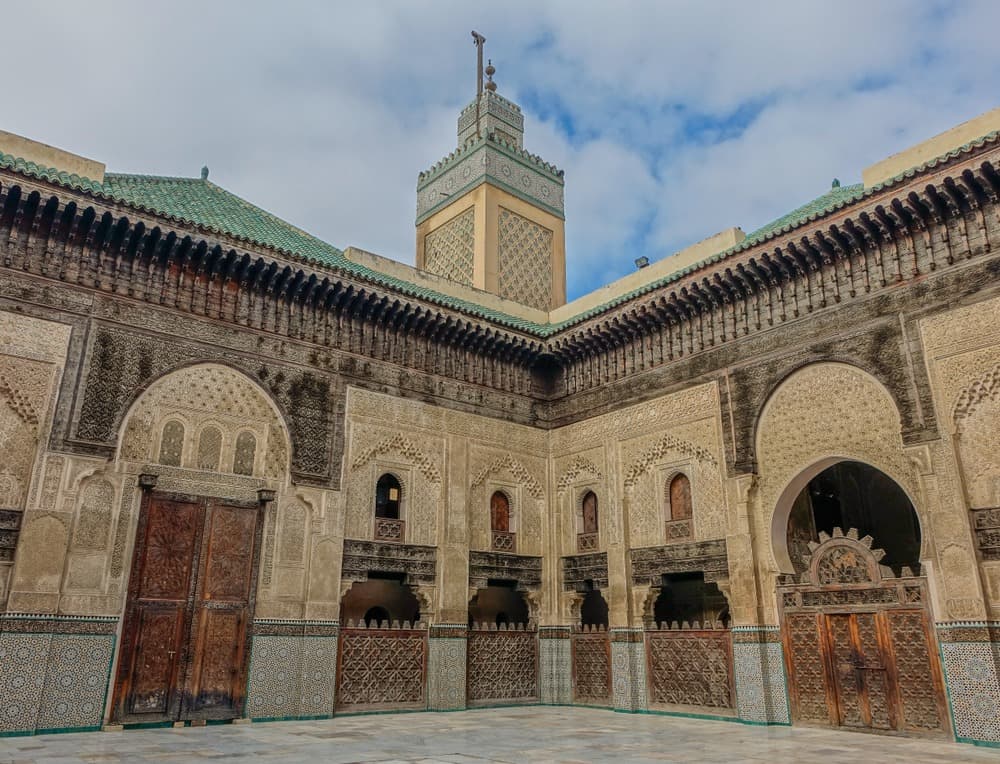
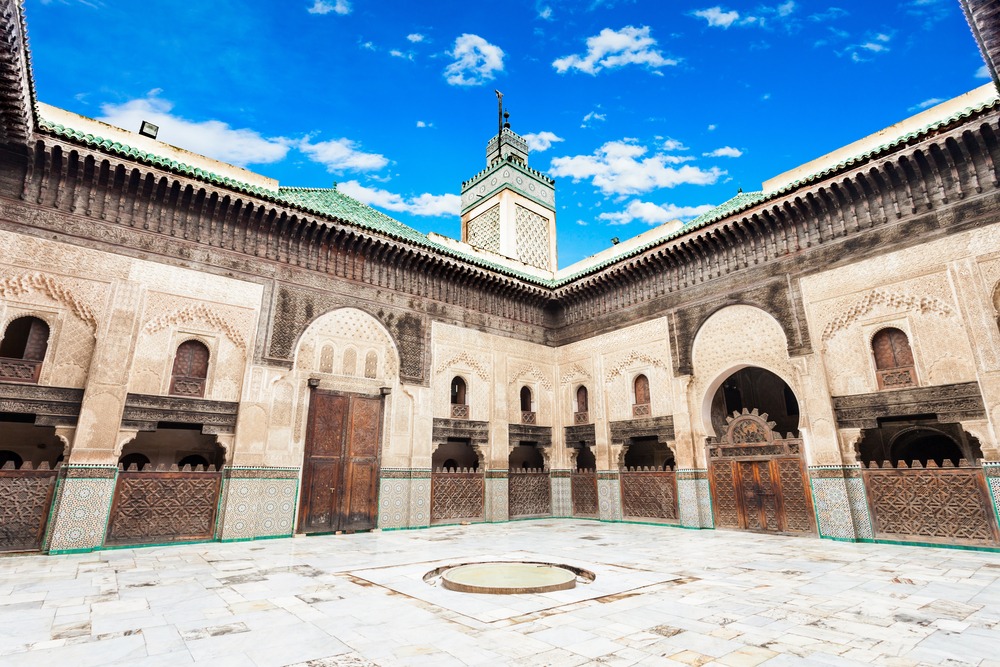
Built between 1323 and 1325 by Marinid Sultan Abu Sa'id, al-Attarine medersa exemplifies the height of Marinid decoration in Fès: stucco, calligraphy and zellige mosaics.
The al-Attarine medersa stands at the entrance to the perfumers' souk, in the historic heart of Fès. Built between 1323 and 1325 under the Marinid dynasty, it ranks among the most refined theological schools of medieval Morocco. Despite the constraints of a narrow site, its architects created a building of remarkable decorative coherence, where stucco, calligraphy and zellige mosaics interplay harmoniously.
Why visit al-Attarine medersa
Al-Attarine exemplifies Marinid architectural mastery at its peak. Three decorative techniques unfold across the courtyard walls: carved stucco with arabesque motifs, painted Arabic calligraphy and geometric zellige tile mosaics. According to tradition, zellige mosaics appear only on walls: considered sacred images, they may not be walked upon.
More modest in size than other medersas in the medina, the building strikes visitors with the density of its ornamentation and the ingenious solutions adopted to adapt to the constraining terrain.
History and Marinid context
Fès, founded in the late 8th century, long served as Morocco's capital and a major center for Islamic learning. Under the Marinids in the 13th and 14th centuries, the city saw the flourishing of a network of medersas designed to train religious and administrative leaders for the empire. These schools provided both Qur'anic and religious sciences instruction, as well as student housing.
The al-Attarine medersa was commissioned by Marinid Sultan Abu Sa'id Uthman II, who had it built between 1323 and 1325. The sovereign had previously commissioned two other important establishments in Fès: the Es-Sahrij and al-Jedid medersas. The name al-Attarine means "the perfumers" in Arabic, referring to the neighboring souk specializing in perfumes and spices, which still borders the monument's entrance today.
What to see on site
The central courtyard
The heart of the complex, the rectangular courtyard concentrates the essential decoration. Stucco bas-reliefs, calligraphic friezes and zellige panels layer without overwhelming the eye. Above the arcades, the upper-floor façades are pierced with finely carved windows, open to the courtyard.
The upper floor and student rooms
A staircase located south of the entrance vestibule leads to the second floor, where 30 rooms served as chambers for resident students. The overall layout is comparable to the as-Sahrij medersa, built during the same reign.
The ablution hall
North of the vestibule, a doorway leads to the mid'aa, the ablution chamber designated for ritual washing before prayer.
The prayer hall and mihrab
On the east side of the courtyard, an ornate gallery provides access to the prayer hall. Most Marinid medersas were oriented so their principal axis followed the qibla, making the mihrab visible from the courtyard. At al-Attarine, the site's narrow constraints forced architects to adopt an atypical arrangement: the mihrab is placed on the south wall, perpendicular to the building's main axis. The hall takes on a rectangular form and features in its northern section three arches surmounted by a square wooden dome that crowns the mihrab. This adaptation testifies to Marinid architects' expertise in adapting to the medina's urban constraints.
Practical information
- Location: at the eastern end of Tala'a Kebira street, in Fès medina, bordering the Attarine souk.
- Visit duration: allow approximately 30 to 45 minutes to explore the courtyard, upper floor and prayer hall.
- Admission: modest entrance fee; group rates available. Conditions may change, check on site.
- Hours: open daily during daylight hours. Schedule may vary during religious holidays and Ramadan.
- Dress code: modest, covering attire recommended, as the site remains a place of worship.
How to get there
Fès is served by several European airlines, with regular connections from France and Belgium. From Fès-Saïs airport, taxis and buses reach the city center in about twenty minutes.
The medersa is located in the heart of the medina, closed to motor traffic. The simplest approach is to reach one of the main gates (notably Bab Boujloud) on foot, then follow Tala'a Kebira street up to the Attarine souk. Orientation in the side streets can be tricky: maps are rarely complete, so don't hesitate to ask shopkeepers for directions.
What to see nearby
The medersa sits within a sector dense with historic monuments:
- The Attarine souk, right before the building, dedicated to perfumes and spices.
- The Karaouiyne mosque and university, a short walk away, one of the world's oldest institutions of higher learning.
- The Bou Inania medersa, another Marinid masterpiece located at the other end of Tala'a Kebira.
- To compare Saadian and Almohad architecture, the Ben Youssef medersa in Marrakech offers a complementary perspective.
- Those who appreciate palace architecture will enjoy the Bahia Palace, also in Marrakech.
Frequently asked questions
Frequently asked questions
The name means "the perfumers" in Arabic. It refers to the neighboring souk, specialized since the Middle Ages in the trade of perfumes and spices, at the entrance of which the medersa was built.
It was commissioned by Marinid Sultan Abu Sa'id Uthman II, who reigned over Morocco in the early 14th century. Construction took place between 1323 and 1325.
No. It no longer accommodates students and now functions as a heritage site open to visitors. The prayer hall, however, retains its religious character.
This perpendicular arrangement to the main axis is atypical for a Marinid medersa. It is explained by the site's narrow constraints, which did not allow for a classical alignment with the qibla as viewed from the courtyard.
Thirty to forty-five minutes are sufficient to observe the courtyard decoration, climb to the upper floor and view the prayer hall. Combined with the Bou Inania medersa and Karaouiyne, plan for a half-day in the neighborhood.
Extend your discovery
Al-Attarine medersa fits naturally into a comprehensive exploration of Fès medina and Marinid heritage. To build an itinerary that pairs Fès with Morocco's other imperial cities, explore our Moroccan journeys.
Interested in this visit?
We can include it in your personalised itinerary.