Kem Kem Plateau
Kem Kem Plateau
Straddling the border between Algeria and Morocco, the Kem Kem Plateau has yielded Cretaceous dinosaur fossils for decades, near Erg Chebbi.
The Kem Kem Plateau stretches across southeastern Morocco, at the border between Algeria and Morocco. This desert relief forms one of the world's most studied paleontological sites: its sediments, roughly 100 million years old, preserve the remains of a tropical ecosystem now vanished. For travelers heading to the Merzouga region, it's a stop that weaves together geology, Saharan landscapes, and the deep history of Earth itself.
Why visit the Kem Kem Plateau
Three reasons make this site remarkable:
- A world-renowned paleontological deposit. The Kem Kem beds have yielded fossils of theropods — Deltadromeus, Spinosaurus, Carcharodontosaurus — that now figure in the collections of major international museums.
- A Saharan landscape at the intersection of diverse landforms. Tabular cliffs, stony plateaus, dried wadi beds, and the immediate proximity of Erg Chebbi's dunes compose a highly legible geological landscape.
- A gateway into eastern Morocco. The plateau is reached from Taouz and allows you to continue on to Merzouga, Rissani, and Erg Chebbi along a single itinerary.
History and paleontological significance
Late in the Cretaceous, roughly 100 million years ago, the region now covered by the Sahara bore no resemblance to an arid wasteland. A vast fluvial system irrigated humid tropical zones, teeming with giant fish, crocodylomorphs, and large terrestrial predators. The sediments deposited during this era form today's sandstone and clay layers of the plateau.
A 2020 study by Nizar Ibrahim's team catalogued the vertebrates of the Kem Kem beds and concluded that this environment harbored an unusual concentration of large carnivorous predators, making it, according to the authors, one of the most dangerous ecosystems ever documented for a terrestrial vertebrate. Spinosaurus, semi-aquatic and of massive size, stands as its emblematic figure. Carcharodontosaurus, depicted in Mark Hallett's painting Thunder Across the Delta, completes this tableau of giant carnivores.
As Charles Darwin noted, the fossil record remains imperfect: remains pass through phases of geological transformation that complicate their dating and interpretation. Much of paleontologists' work consists precisely in reconstructing the age and origin of each specimen to understand the prehistoric ecology of the region.
Over the decades, collaboration has flourished between international researchers and local fossil hunters. Many specimens displayed in museums worldwide pass through Moroccan rock shops before being studied and identified.
What to see on site
The Anti-Atlas and its Paleozoic fossils
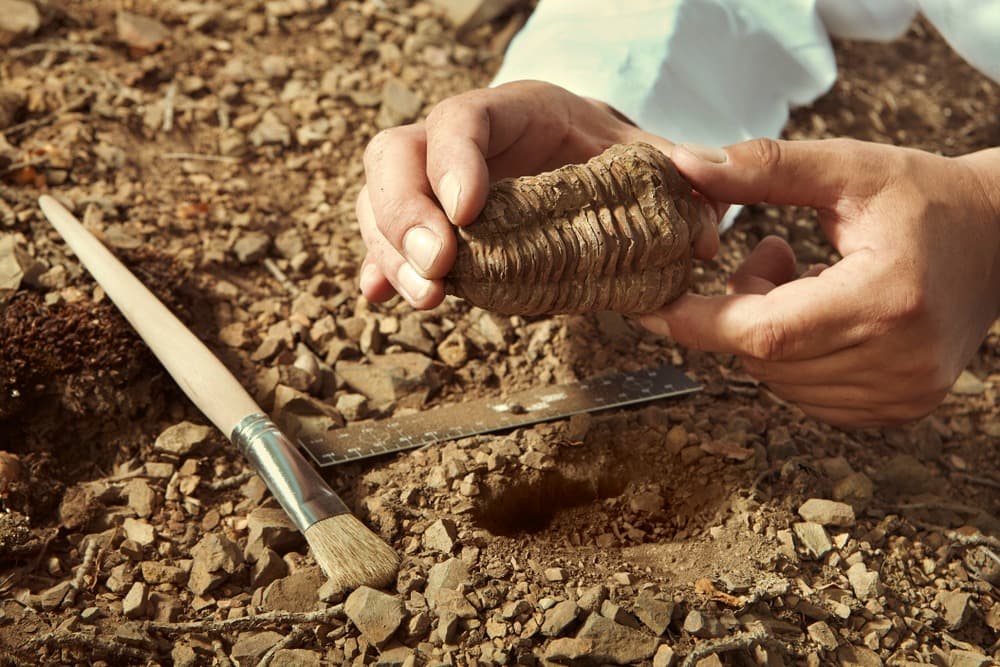
The Anti-Atlas massif, composed largely of Paleozoic rocks (245 to 570 million years old), frames the region. Its limestones from the Cambrian, Ordovician, Silurian, and Devonian epochs contain trilobites — distant ancestors of modern arthropods — and Orthoceras, cone-shaped nautiloids often polished and displayed in local shops.
Sites on the plateau itself
The plateau stretches some 250 kilometers toward the Algerian town of Zegdou. On the Moroccan side, you'll traverse:
- Desert tracks that run along sandstone cliffs, accessible by 4x4.
- The dried Ikiri lake, a vast flat surface passable by all-terrain vehicle.
- The dunes of Erg Chebbi, nearby, marking the transition to the grand erg.
Fossil shops and small museums
Around Rissani, Erfoud, and Taouz, several workshops display and prepare fossils extracted from the region. It's an opportunity to see firsthand how trilobites, ammonites, and dinosaur bones are extracted from surrounding rock.
Practical information
- Length of visit: Plan for a full day from Merzouga or Rissani for a 4x4 excursion on the plateau; longer if you combine it with Erg Chebbi.
- Equipment: Plenty of water, sun protection, closed-toe shoes, and a headscarf for sandstorms.
- Guide: Hiring a local guide is strongly recommended. The tracks are poorly marked, and the border zone requires respecting certain routes.
- Rates: Access to the plateau is free, though a 4x4 excursion with driver-guide from Merzouga remains the most common option, at a moderate rate for a half-day or full day.
When to go
The southeastern Moroccan climate is desert-like. The months from October through April offer the most comfortable conditions, with mild days and cool to cold nights in the depths of winter. From June to August, daytime temperatures frequently exceed 40°C (104°F), making excursions on the plateau grueling. Spring remains the most pleasant season for combining Kem Kem, Erg Chebbi, and the southern valleys.
How to get there
The main access point is the town of Taouz, south of Merzouga. From Marrakech, allow roughly ten hours of driving via the N12 and N9 highways, passing through Ouarzazate, the Drâa Valley, and then Rissani. Most travelers split the journey over two days, with a stop in Ouarzazate or the Dadès Valley. From Merzouga, Taouz is reached in less than an hour on tracks.
Nearby
- Erg Chebbi and Merzouga: Morocco's most iconic dune belt, just a few kilometers to the north.
- Rissani: Former capital of the Tafilalet, lively marketplace, and birthplace of the Alaouite dynasty.
- Taouz, the logical starting point for exploring the plateau.
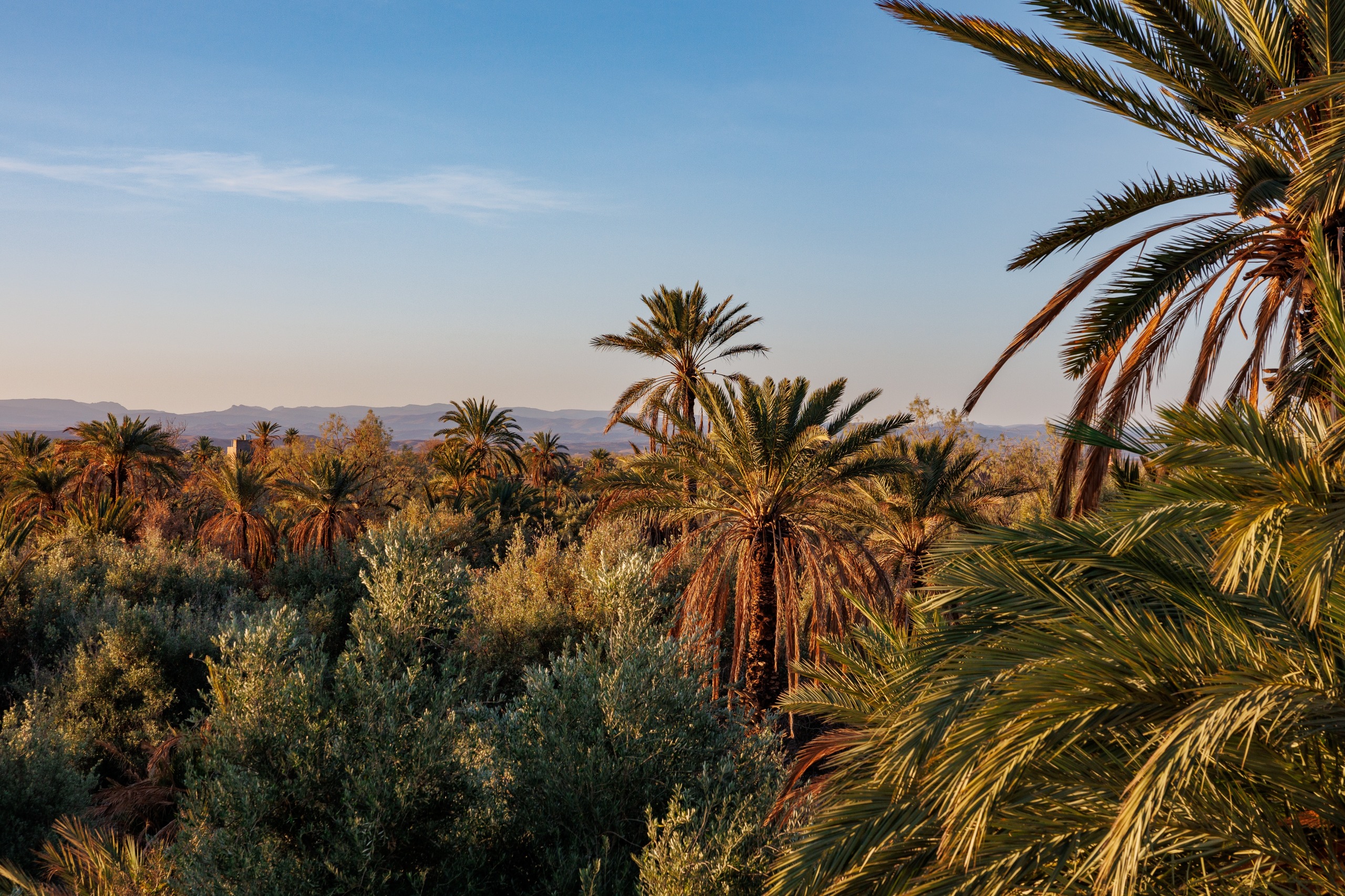
- The Skoura Palm Grove on the return route toward Ouarzazate.
- Attiq Waterfalls to extend your itinerary toward the High Atlas.
Frequently asked questions
Frequently asked questions
Personal collection of surface pieces is tolerated in certain areas, but fossil export is regulated by Moroccan law. It's best to purchase from registered workshops in Erfoud or Rissani, which provide certificates.
Excavations have notably yielded remains of Spinosaurus, Carcharodontosaurus, and Deltadromeus, three large predatory theropods, as well as numerous fish, crocodylomorphs, and pterosaurs.
Yes, provided you opt for a guided 4x4 excursion and manage the heat carefully. Children especially enjoy the "fossil hunting" aspect and proximity to Erg Chebbi's dunes.
Access to Taouz is by paved road, but exploring the plateau's tracks and Ikiri Lake requires an all-terrain vehicle and, ideally, a local driver-guide.
Plan your trip
To integrate the Kem Kem Plateau into an itinerary combining Marrakech, the Drâa Valley, Merzouga, and Erg Chebbi, explore our suggestions on our Morocco journeys. Our local teams can assemble a custom route including a 4x4 excursion, a night in a desert bivouac, and meetings with the amateur paleontologists of Rissani.
Interested in this visit?
We can include it in your personalised itinerary.