Night in the Moroccan Desert: An Experience Not to Be Missed!
Spending a night bivouacking in the Sahara promises an unforgettable experience… Endless dunes, star-filled skies and encounters with nomads, it offers true disconnection,
Spending a night bivouacking in the Sahara is the promise of an unforgettable experience… Endless dunes, star-filled skies and encounters with nomads, it offers true disconnection, as well as immersion in Berber culture. From the Agafay desert to the remote lands of Laâyoune and Dakhla: discover where to sleep in the Moroccan desert!
Bivouacking in the Sahara: What to Expect?
The Advantages of the Experience
Unlike camping, bivouacking is an ephemeral and minimalist encampment (though there are also, as we'll see, comfortable bivouacs). In addition to offering immersion in nomadic life, bivouacking is an opportunity to:
reconnect with nature (by witnessing the sunset or observing the stars),
reconnect with loved ones around a unique experience (or a campfire, in the silence of the Saharan dunes),
share authentic moments with Berber hosts or Tuaregs, eager to share their way of life and traditions.
Spotlight on the nomadic life of the Tuaregs… Originally, the Tuaregs moved through the mountainous regions of the Sahara with the seasons, in search of water (for their livestock's survival), as well as for the transportation of goods, as part of trans-Saharan trade. Unfortunately, this way of life has been gradually disappearing since the twentieth century, due to political or socio-economic changes and the modernization of infrastructure. In the twenty-first century, the population of this Berber people is estimated at 1.5 million1. Tourist experiences allow their traditions and way of life, which are on the verge of extinction, to be perpetuated. |
Types of Bivouac
Traditional Tents
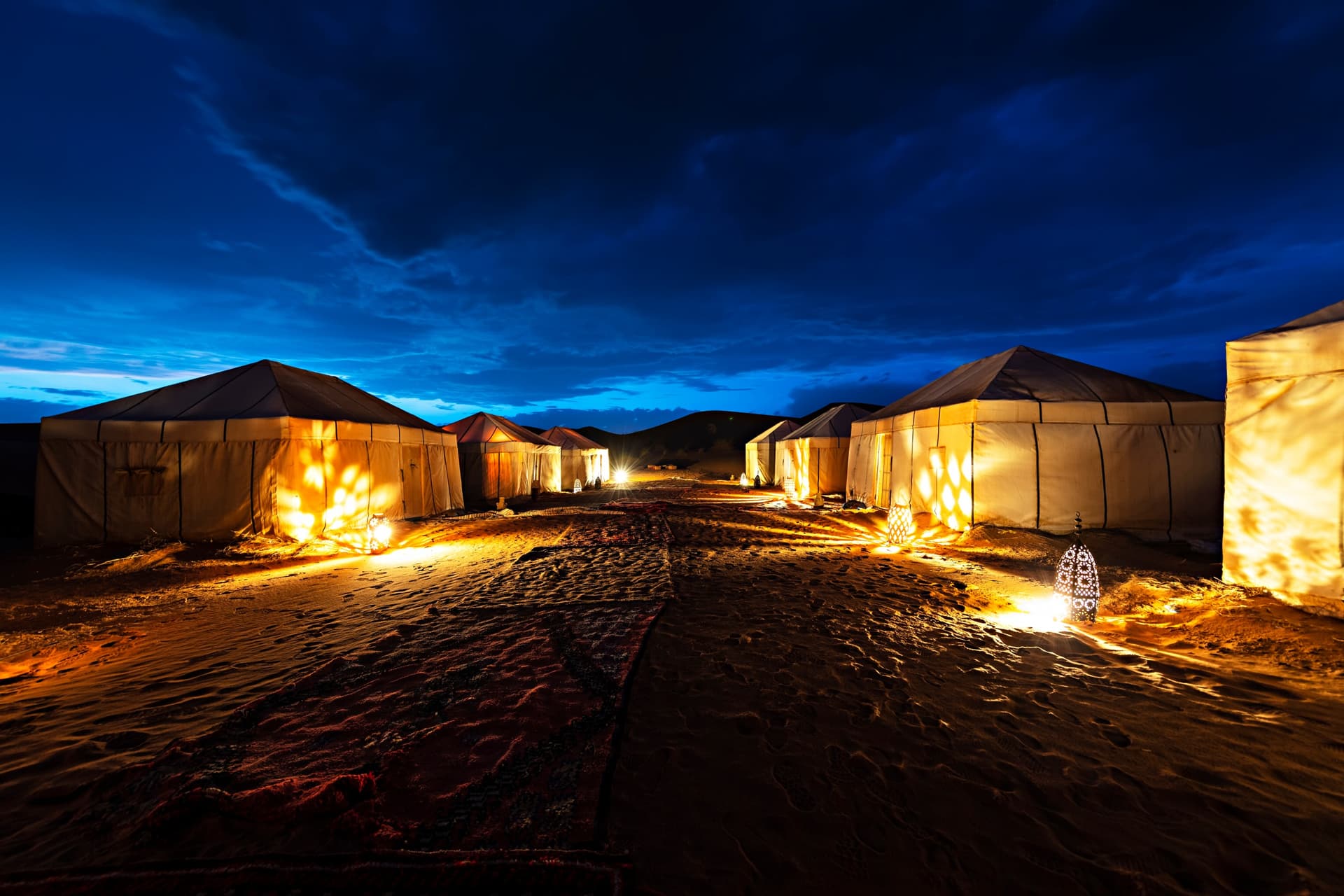
The traditional bivouac of the Tuaregs is quite simple. Their encampment consists of khaïmas, that is, tents made of resistant canvas, mounted on wooden frameworks. These are designed to be easily set up and taken down during different stages of the journey.
The interior of the tents is covered with cushions and handwoven carpets made with natural materials. There are two types of encampment where you can sleep in a khaïma:
Wild Camping
For an authentic experience as close as possible to the life of the Tuaregs: this is THE quintessential bivouac! It is an itinerant encampment, set up in the heart of the dunes as you progress through the desert. These shelters, fashioned on ancestral models, withstand wind and sandstorms. Wild camping can also be done with classic tents, Quechua-type.
During a trek in the desert, note that everything needed (tents, blankets, food, cooking utensils, etc.) is transported by camels. This bivouac is also the closest to a night under the open sky!
How to Use the Restroom in the Desert During a wild bivouac, natural needs are taken care of in the hollow of a dune away from view. In this case, be sure to bring toilet paper – and a lighter to burn it after use. It is strictly forbidden to bury the paper under the sand (and to leave waste behind) out of respect for the place and the environment! |
Bivouacking in a Camp
If you wish to sleep in a khaïma but are concerned about lacking comfort, then bivouacking in a fixed camp is the best solution. In this case, you will spend the night under a traditional tent, but enjoy the camp's facilities (toilets and showers). Water pressure there is sometimes low (the water comes from a cistern), but this still allows for a quick shower in the desert!
Price: approximately €60/night for adults; €30/child).
➡️ Discover our Bedouin stay in the Sahara
Luxury Tents
Like glamping (accommodation in the heart of nature that combines glamour, camping and comfort), luxury bivouacs allow you to sleep in the desert while enjoying premium services, including:
large tents worthy of 5-star hotels (refined decoration, double beds, dining area where you can dine together over a Moroccan specialty, air conditioning, electricity in the tents, private toilets, etc.).
Premium services (welcome tea, attentive staff, possibility of having breakfast in the tent, transfers to the camp by 4x4 or camel, etc.).
Depending on the camp, you may have the chance to relax in a hammam or take a dip in a swimming pool, set there like an oasis in the middle of the desert!
Price: approximately €200/night/adult
The Course of an Excursion
The simplest way to organize your nights in the Moroccan desert is to contact a local agency. This option ensures a safe experience, but also allows you to benefit from an organization tailored to you with the services of a guide, driver and camel herder.
Transfer to the Desert from a Major City
Upon your arrival in Maroc, you will be picked up in one of the main cities serving as departure points for an excursion into the desert: Marrakech, Agadir, Laâyoune and Ouarzazate – most of the time. Transfer conditions depend on your agreement with your agency.
Stay Conditions Once There
The conditions of your stay, activities and services depend on your agency, but also on the type of accommodation chosen… Here is an example of a program departing from Laâyoune (on full or half board), to give you an idea of a typical desert stay:
Transfer by 4x4 from the city,
Visit to Laâyoune,
Half-day excursion by 4x4 in the dunes (to enjoy the views),
Installation in a Bedouin camp (with a change of location for the second night).
Activities You Can Do There
 During a trek or a stay of several days, you will have the opportunity to enjoy many activities, including:
observe the stars: the Sahara is a privileged place to observe the Milky Way and see shooting stars. Some circuits even include the presence of an astronomy professional! An opportunity to learn more about constellations, and to put yourself in the shoes of a Tuareg (they once used the stars to guide themselves during their trade convoys).
go sandboarding: or THE typical desert sport, which allows you to surf on sand dunes! It is possible to include this activity in a circuit – in which case the equipment will be provided. A fun and safe activity, ideal for reclaiming your inner child…
make a stop at an oasis: depending on your route and the desert visited, you may have the opportunity to discover one of these stunning natural wonders…
meet Tuareg nomads: bivouacking in the desert is also an opportunity to meet the Berber peoples still living in the desert; to discover their customs and traditions (as well as original Moroccan culture).
take camel rides: perfect for a sense of adventure or to watch the sunset!
go trekking through the dunes: walking in the desert is accessible to all and does not require you to be a great athlete. The only constraint is being able to handle the heat.
How Many Nights to Spend in the Desert? If your stay in Maroc does not allow you to linger in the desert, one night bivouacking is still recommended so you can immerse yourself in Tuareg culture and admire the sunset in the Saharan dunes! If you have a bit more time, two nights bivouacking allow for true disconnection. |
The Best Locations
The Agafay Desert (Ideal for a Bivouac Close to Marrakech)
Contrary to popular belief, the desert is not always a vast ocean of sand (erg). It can also be a rocky desert (reg), such as the Agafay Desert. Located just over thirty kilometers from Marrakech, this rocky plateau is ideal for bivouacking in the Sahara during a brief stay in the "red city." Another advantage? It offers stunning views of the Atlas Mountains!
Erg Chebbi and the Merzouga Dunes
Near the town of Merzouga extends the Erg Chebbi (also called the "Merzouga Desert"). This desert zone, easily accessible by 4x4 from the town of the same name, is home to several accommodations (guesthouses, luxury camps and bivouacs). The ultimate sandboarding spot, the erg also houses prehistoric rock carvings at Taouz. At sunset? Don't hesitate to take a buggy tour…
Erg Chegaga
Located just over 300 km from Marrakech, Erg Chegaga is recommended for a two-day excursion (and one night bivouacking). Accessible from the town of M'hamid (1.5 hours travel) or Ouarzazate (approximately 5 hours drive), the Zagora Desert is a wild site that offers an experience cut off from the world and out of time. As part of a multi-day trek, Erg Chegaga can be combined with a visit to Foum Zguid and its famous Lake Iriki.
The Deserts of Laâyoune and Dakhla
The Laâyoune-Sakia El Hamra region is an administrative region of Maroc that is home to the town of Laâyoune (the largest city in Western Sahara). Located approximately 500 km south of Agadir, it serves as an entry point to a section of desert that stretches along the Atlantic Ocean.
Blessed with good waves, this desert-ocean zone is ideal for surfing or kitesurfing! It is possible to bivouac there in a Bedouin camp. Approximately 530 km south of Laâyoune, you will also find the Dakhla Desert. It is a beautiful coastal region that is not very touristy, with encampments under traditional tents.
When to Bivouac in Maroc? Since the Sahara is one of the hottest desert zones in the world, temperatures can exceed 45°C at certain times of the year. To bivouac, it is therefore preferable to avoid the July-August period. In May, June and September, temperatures range around 30-35°C (and around 20/25°C the rest of the year). Beware, the mercury can drop to 0°C in winter! Conclusion? The best time for a bivouac under the stars of the Sahara is between the months of March and May. |
Practical Tips for a Bivouac in Maroc
If bivouacking is synonymous with adventure, it is nonetheless advisable to know a thing or two for a successful experience…
Equipment and Accessories to Bring
A lightweight backpack (25 to 30 liters),
A pair of sunglasses (index 3 or 4),
SPF 50 sunscreen for optimal UV protection
A lip protection stick,
A flashlight,
A walking stick (if you think you'll need it for the trek),
A toiletries bag (with the bare essentials). Favor wipes or alcohol-free lotions that don't require rinsing.
A small first aid kit (tweezers, blister plasters, antiseptic, etc.),
A sleeping bag (the comfort rating should be adapted according to the bivouac season, read the indications on the label),
An inflatable pillow,
Toilet paper,
A lighter,
Plastic protection for your devices (to protect them from sand),
A Swiss Army knife,
A pair of binoculars (to observe the stars),
A water bottle (with a filter tablet, to purify water, if you don't have access to drinking water),
Energy bars or dried fruit, to regain strength at any time of day.

Clothing
To withstand the daytime and nighttime temperatures of the Sahara, you should bring:
Lightweight pants: even if it's very hot during the day, you must absolutely dress in long pants to avoid being burned by the sun's rays. Ideally, opt for a moisture-wicking material and a somewhat loose fit, to avoid the friction of seams which can be painful due to heat.
Clothing and undergarments in natural materials (more breathable) for the daytime excursion. Avoid synthetic materials (like nylon and polyester unsuitable for high heat) and favor light colors, such as white or beige, which reflect light and reduce the sensation of heat.
Moisture-wicking socks
Hiking boots (already worn to ensure they don't hurt) and of good quality for reliable protection and support. Note that traditional hiking boots (often high and rigid) are not suitable for trekking in sand).
A head covering: regardless of the style, the important thing is that you protect your head to avoid the risk of sunstroke. During the day, remember to protect the back of your neck or choose a wide-brimmed hat). You can also buy a Tuareg tagelmust in one of the departure cities (approximately €8).
A pair of lightweight gloves (and UV-protective, to protect your hands),
A sweater (temperatures are cool once night falls),
A fleece jacket and a waterproof jacket (if bivouacking between December and February)
Thick socks for the night,
A pair of sandals for the evening,
Bivouacking on the White Beach… On the coastal road that connects Tan-Tan and Agadir lies another must-see natural site in Maroc: the white beach. It is a superb beach with crystal-clear waters, stretching 40 km along the Saharan dunes! It is possible to spend a night there at the Aoreora fort. To learn more, discover our white beach bivouac circuit! |
Frequently Asked Questions
Where to Bivouac in Maroc?
The main camping sites for bivouacking in the Sahara Desert in Maroc are: the Agafay Desert (closest to major cities), the Merzouga Desert (Erg Chebbi), the Zagora Desert (Erg Chegaga), Laâyoune Province and the Dakhla Desert (in Western Sahara).
What is the Most Beautiful Desert in Maroc?
No desert in Maroc stands out more than others by its beauty. The desert zone to visit as a priority depends mainly on the departure city and the activities you wish to do in the Sahara. Sandboarding, camel rides, dune trekking, kitesurfing, encounters with nomadic peoples, etc.: the choice of program suggests for itself which desert is most interesting to visit!
Why Does the Tuareg Man Cover His Face?
The tagelmust (Tuareg tagelmust) serves to protect the face from sand and sun, but not only… Indeed, this traditional cloth is also a sign of virility, which men don this upon their entry into the adult world. The color of the tagelmust also carries a unique symbol (social status, devotion, respect, etc.)
Is There Cell Reception in the Moroccan Desert?
In the Saharan desert zones, only 3G can be picked up (at the summit of certain dunes). Like M'Hamid El Ghizlane, some small towns serving as gateways to the desert are equipped with internet cafes.
(1) Source: Le360 website.
Frequently asked questions
The price of a night bivouacking in Maroc varies depending on the level of comfort chosen. Budget approximately €30 to €60 per person for a bivouac in a traditional camp (khaïma with access to facilities), and around €200 per person for a luxury bivouac with high-end tent, premium services and hotel comfort.
For a bivouac in the Moroccan Sahara, remember to bring: a lightweight backpack (25-30 liters), SPF 50 sunscreen, sunglasses (index 3 or 4), a sleeping bag adapted to the season, a water bottle with filter tablet, a flashlight, toilet paper with lighter, a first aid kit and covering clothing in natural materials for day and night.
It is strongly discouraged to bivouac alone in the Moroccan desert, particularly in remote areas like Erg Chegaga or the Laâyoune and Dakhla deserts. It is recommended to go through a local agency that will provide an experienced guide who knows the terrain, thus ensuring your safety and an enriching experience.
Erg Chebbi, located near Merzouga, is the most accessible and touristy sand desert in Maroc. It is ideal for a first experience of the Sahara. Erg Chegaga, more than 300 km from Marrakech and accessible from M'hamid (1.5 hours travel) or Ouarzazate (approximately 5 hours drive), is wilder and more remote, recommended for those seeking an out-of-time experience and true disconnection.
Yes, nights in the Moroccan desert can be very cool, even cold. In winter (December to February), temperatures can drop to 0°C. Even in April or October, they can fall to 10-15°C after sunset. It is therefore essential to bring a sleeping bag suited to the conditions and warm clothing (sweater, fleece jacket, waterproof jacket in winter).