Moroccan Sahara
Moroccan Sahara
From the dunes of Merzouga to the ksour of the Drâa valley, the Moroccan Sahara blends sand landscapes, earthen architecture and nomadic culture. Practical guide to organizing your desert journey in Morocco.
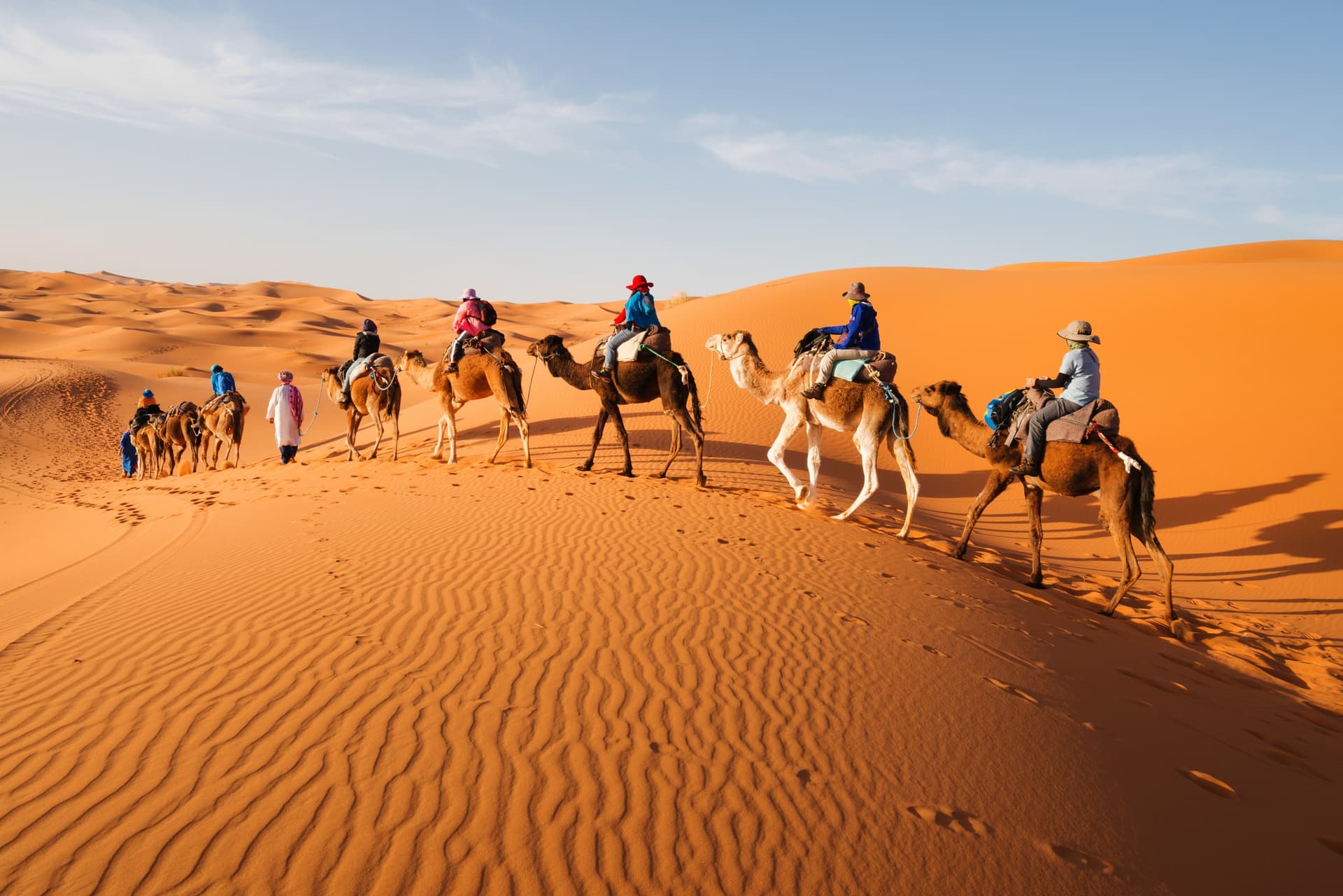
The Moroccan Sahara stretches south of the Atlas Mountains, from the valleys of the Drâa and Dadès to vast sand ergs. Merzouga and its Erg Chebbi dunes, Zagora and the Drâa valley, M'Hamid el-Ghizlane and the Erg Chigaga: three distinct gateways, three distinct atmospheres. This desert is far more than scenery — it is inhabited, crisscrossed by caravan routes and earthen ksour that tell a thousand years of trans-Saharan trade.
Quick practical facts
Best time: October to April — bearable heat, cool to cold nights.
Access: Merzouga is roughly 50 km from Erfoud (paved road); Zagora is accessible from Ouarzazate; M'Hamid el-Ghizlane lies about 90 km south of Zagora.
Dress code: cover shoulders and legs to respect local customs; bring a tagelmust (Saharan head wrap) against sand and sun.
Recommended duration: minimum 2 nights — one night bivouacking in the dunes and one in a ksar.
Wheelchair accessibility: limited — tracks and sand make most sites difficult to access with mobility aids.
What to see
The dunes of Erg Chebbi near Merzouga reach up to 150 metres in height and shift from ochre to pink depending on the light. Erg Chigaga, more remote, is accessible only by 4×4 or camelback from M'Hamid. The Drâa valley unfolds a continuous palm grove dotted with ksour and collective granaries (agadirs). The Todra and Dadès gorges, at the desert's edge, offer spectacular rocky walls.
History and context
The Moroccan Sahara was for centuries a crossroads for trade between sub-Saharan Africa and the Maghreb. Gold, salt, slaves and spices passed through way-stations like Sijilmassa (near Erfoud), now in ruins. Berber tribes such as the Aït Atta and Sahrawi nomads shaped a desert culture blending earthen architecture, gnaoua music and codified hospitality. French colonization in the 20th century carved out tracks that became today's roads.
Highlights of a visit
Sunrise and sunset over Erg Chebbi
Low-angle light transforms the dunes into shifting sculptures. The climb on foot or camelback to a ridge takes between 30 and 60 minutes depending on the starting point. Wear closed shoes — sand burns in daylight and slips underfoot on the descent.
Night under the stars in a bivouac
Far from light pollution, the Saharan sky is extraordinary. Fixed camps offer equipped Berber tents; nomadic bivouacs, organized by local guides, provide a more authentic experience away from mass-market circuits.
The ksour of the Drâa valley
Aït Ben Haddou is the most famous (UNESCO-listed), but Aït Ben Haddou is just one among dozens. Tamegroute, with its library of ancient manuscripts and green pottery, deserves a stop. Zagora remains a good base for exploring the valley.
Gnaoua music and nomadic culture
Descendants of sub-Saharan slaves developed a ritual music — gnaoua — still vibrant in southern villages. Some camps arrange evenings with local musicians, far from polished tourist performances.
Photography tips
Golden hour: the first 30 minutes after sunrise and before sunset cast the sharpest shadows on the dunes.
Avoid midday: light is flat and heat creates mirages that wash out detail.
Protect your gear: sand infiltrates everything — use a waterproof bag or protective cover.
Ask permission: photographing people, especially women, without consent is considered disrespectful.
Location and access
The Moroccan Sahara is accessible via three main routes:
Ouarzazate – Zagora – M'Hamid route: paved road to M'Hamid, then track to Erg Chigaga.
Errachidia – Erfoud – Merzouga route: paved road to Merzouga, direct access to Erg Chebbi.
From Marrakech: roughly 9 to 10 hours by road to Merzouga via the Tichka pass or Tizi n'Tichka pass.
CTM and Supratours bus services link Marrakech to Ouarzazate and Zagora. For Merzouga, a connection in Erfoud is usually required. Hiring a 4×4 with driver remains the most flexible solution for exploring remote tracks.
Nearby
Aït Ben Haddou — UNESCO-listed ksar, setting for numerous Hollywood films, about 30 km from Ouarzazate.
Todra Gorges — vertical walls over 300 metres high, renowned climbing site, about 2 hours from Merzouga.
Dadès Gorges — winding road between red cliffs, Berber villages clinging to the walls.
Ouarzazate — the "Hollywood of the desert", film studios and Taourirt kasbah.
Drâa Valley — 200 km palm grove, earthen ksour, Tamegroute oasis.
Frequently asked questions
October to April offers pleasant daytime temperatures and cool to cold nights. Summer (June to August) is not recommended: temperatures regularly exceed 45 °C in the dunes.
For Erg Chebbi, a guide is not mandatory but recommended for hikes longer than a day. For Erg Chigaga, a local guide and 4×4 are essential — tracks are poorly marked and conditions can change rapidly.
Yes, but allow a minimum of 7 to 8 days. The two sites are about 5 to 6 hours apart by road. A loop circuit from Marrakech via Ouarzazate, Zagora, Merzouga and the Ziz Pass is classic and achievable.
Light but covering clothes (long sleeves, trousers) for sun and sand protection. A tagelmust or scarf is useful against sandstorms. At night, even in autumn, temperatures can drop near freezing — bring a warm layer.
Landscapes and architecture photograph freely. For people, always ask permission — it is a fundamental courtesy in Berber and Sahrawi communities.
CTM and Supratours buses connect Marrakech to Ouarzazate and Zagora. For Merzouga, local buses depart from Errachidia or Erfoud. Shared taxis fill gaps between smaller towns. The most comfortable option remains renting a vehicle or booking an organized tour with a driver.
Want to discover this destination?
Our local advisors design your tailor-made trip.