History
Morocco's history begins in prehistoric times. Evidence suggests that early humans already inhabited the region, living by hunting and gathering with tools such as pebbles.
Morocco's history begins in prehistoric times. Evidence suggests that early humans already inhabited the region, living by hunting and gathering with tools such as pebbles. The Mousterian period followed, characterized by evolving tool-making techniques. The Paleolithic era marks the arrival of Homo sapiens, with tools discovered in Oujda. This population would eventually be displaced by the ancestors of today's Berber populations, the Capsians arriving from the east. During the Neolithic period, settled communities emerged alongside the birth of agriculture.
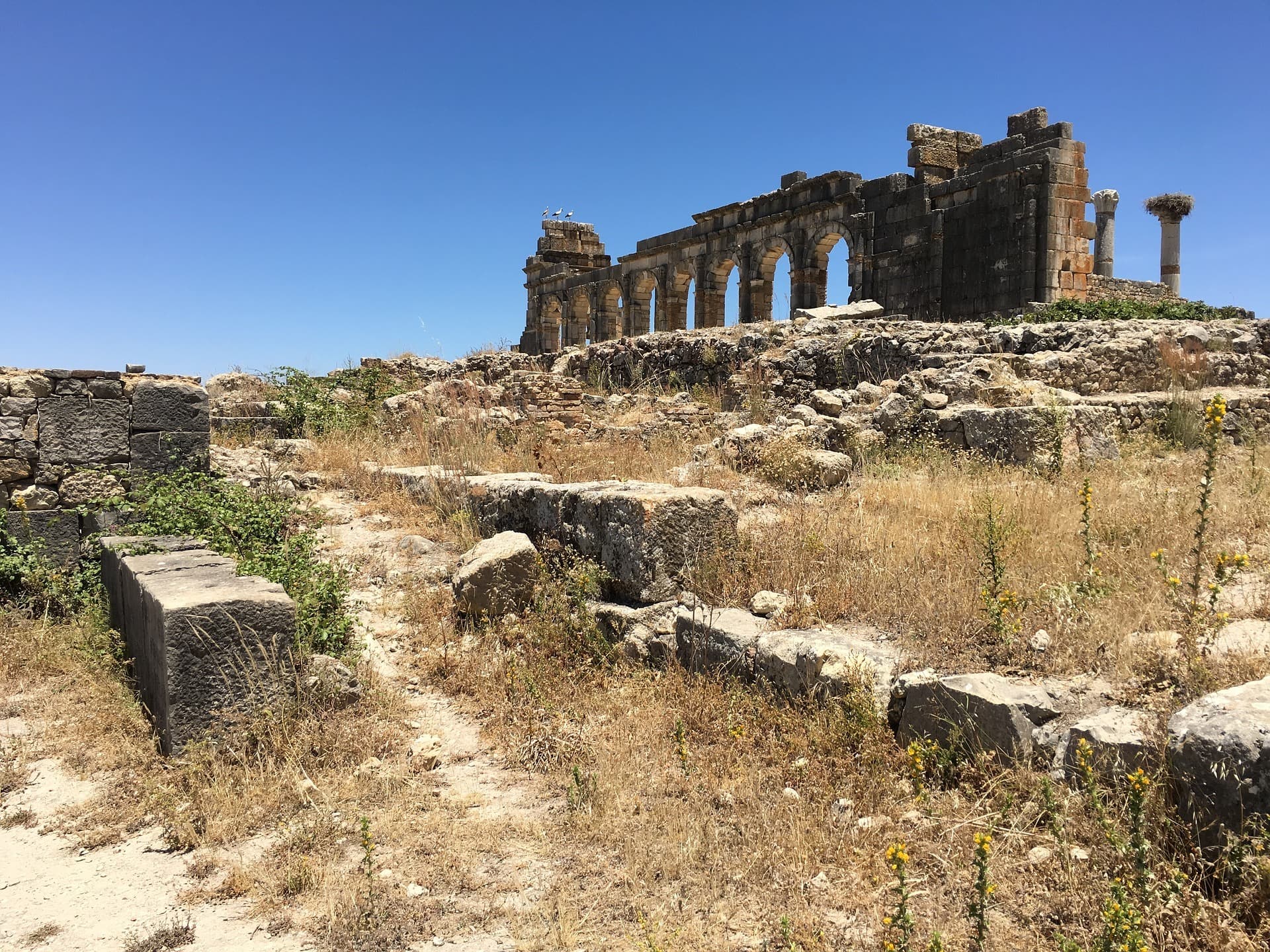
During antiquity, the Phoenicians established the first settlements along the coasts and founded trading posts such as Tangier. From Antiquity until 638, various powers sought to conquer Morocco. The region became known as the Kingdom of Mauritania in the north, and later as Mauritania Tingitana. The Romans attempted to settle there but were ultimately unsuccessful. Nevertheless, they began constructing monuments and exploiting the land. By the end of the Antique period, the kingdom fell under Byzantine control.
In 649, the Arabs reached the Maghreb and sought to displace the Berbers, who mounted fierce resistance. During this era, Islam became the predominant religion. History during this period was marked by repeated revolts between Berbers and Arabs. Morocco fell under Umayyad domination, only to be overthrown by the Abbasids. Complete chaos ensued.
The foundation of Morocco was established with the help of the Idrissids, who rallied numerous tribes. However, it was the Almoravides who would give the country its name by founding the capital, Marrakech. As Morocco established itself, the rest of the Maghreb fragmented into independent territories. Disagreements emerged and foreign powers sought to seize control. In 1911, Morocco was partitioned between France and Spain.
From 758 to 1664, Morocco's history experienced profound upheaval as successive kingdoms and dynasties rose and fell, including the Kingdom of Sijilmassa, the Kingdom of the Berghouata,
the Idrisside Dynasty, the Umayyads of Córdoba and the Fatimids, the Meknassa and Maghraoua, the Ifrenides, the Almoravides, the Almohad Dynasty, the Marinid Dynasty, the Wattasids, the arrival of Andalusians and Moriscos who left their mark on architecture and fortifications, and finally, the Saadian dynasty.
Then Morocco began to assert itself under the Alaouite Sultans, the greatest of whom was Sultan Moulay Ismail. This Sultan maintained cordial relations with France. However, when France signed agreements with Spain, the Sultan was displeased and severed all relations with France. From 1727 to 1909, numerous other Sultans succeeded one another amid battles with various powers. During the 19th century, Morocco became the target of foreign powers—France, Spain, and the United Kingdom—who sought to take control for economic reasons. Sultan Moulay Hassan worked tirelessly to preserve his country's independence, but upon his death, his successor Abd Al-Aziz plunged the nation into grave crisis. In 1904, an accord was reached among the three powers, with Morocco falling under French control and northern Morocco under Spanish control. Abd al-Aziz decided to revolt, triggering the Tangier crisis. In 1911, the Agadir Incident sparked a military crisis, with Germany as the precipitating factor. From 1912 to 1956, Morocco existed under Spanish and French protectorate. World War I inflicted heavy casualties on French troops stationed in Morocco. The Rif War of 1921 saw Berbers rise up against the Spanish; despite Spain's superior forces, they were decisively defeated. Morocco was impacted by World War II, and in 1942, Americans landed on Moroccan shores.
From 1930 to 1955, Morocco's history centered on the path to independence. Throughout these years, meetings, treaty signings, and negotiations with Spain took place to secure Spain's withdrawal. In 1956, France accepted the principle of Moroccan independence, and an agreement was finally reached between Mohammed V and the King of Spain, ending Spanish occupation. Morocco was finally an independent nation, and Tangier was fully integrated into the country. In 1963, the Sand War erupted between Morocco and Algeria over border disputes, but it ended quickly with borders remaining unchanged. From 1975 until 1991, Morocco fought to recover Western Sahara. Tensions continued to flare between Algeria and Morocco until 1988. That same year, Algeria and Morocco officially reconciled, each retaining its territory and borders being restored. In 1989, Morocco's history took a positive turn. Indeed, in Marrakech, a meeting