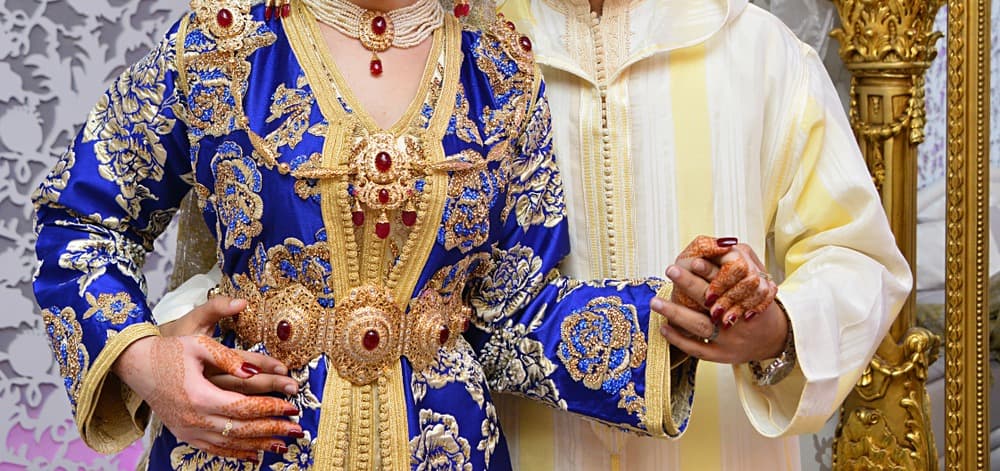
Traditional Moroccan Clothing
Caftan, djellaba, babouches. These Moroccan garments are particularly emblematic of the country's cultural and artistic diversity. Since the emergence of weaving 1500 years before Christ, all the manufacturing processes for these typical clothes have evolved.
Caftan, djellaba, babouches. These Moroccan garments are particularly emblematic of the country's cultural and artistic diversity. Since the emergence of weaving 1500 years before Christ, all the manufacturing processes for these typical clothes have evolved.
Clothing varies entirely depending on the region, ethnic background, and socioprofessional status. The attire of city dwellers, for instance, bears no resemblance to that of rural inhabitants. Yet everywhere, men traditionally wear djellabas. This garment always features a hood, very wide sleeves, and is tailored from wool or cotton.
Since the mid-20th century, the djellaba has entered the female wardrobe. During this period, Moroccan women abandoned the haïk—a large piece of fabric, usually white, with which they covered their face and body when going out—in favour of the djellaba, which became an outdoor garment. The strictly cut and oversized djellabas of yesteryear have given way to today's feminine versions, which are much more form-fitting, more colourful, and inspired by contemporary fashion trends.
Among other traditional garments is undoubtedly the caftan, whose origins trace back to the Ottoman Empire. It is a long robe for women, typically worn for special occasions. Generally elegant and refined, the caftan is a festive garment. Tailored from noble materials—velvet, silk, and brocade—it is set with gold or silver thread and adorned with sumptuous embroidery. The caftan is also a garment worn at home.
In the range of traditional Moroccan clothing, one also finds the burnous (black or white), worn over the djellaba, and the wide, billowing trousers known as the saroual. Men also occasionally wear a fez or a white turban in rural areas for certain ceremonies.
All these garments are worn with Morocco's traditional shoes, the famous babouches. Indeed, in this country, leatherwork is the product of centuries-old craftsmanship. In fact, the word "maroquin" was given to goat and sheep leather produced in Maroc from the 14th century onward. Although the babouche has been replaced, particularly among younger generations, by more modern footwear, it remains greatly appreciated by Moroccans, who wear it at home and for outings, as well as for ceremonies. There are generally two types of babouches: those with square toes, inspired by Berber tradition, and urban babouches that are more refined, with angular toes and a more elegant appearance. Men's babouches are typically yellow and unadorned. Women's babouches today come in all colours and are sometimes decorated with gold or silver thread.