Moroccan Art
Moroccan art is highly prized across the world. Particularly diverse, it is the legacy of centuries of prolific craftsmanship. The story of art in the kingdom indeed begins in the Neolithic period, and it has
Moroccan art is highly prized across the world. Particularly diverse, it is the legacy of centuries of prolific craftsmanship. The story of art in the kingdom indeed begins in the Neolithic period, and it has continually asserted itself everywhere—in decoration, furnishings, architecture, and beyond—while modernizing along the way. This is undoubtedly what explains its current success. Highly significant to the country's economy, Moroccan art today represents nearly 70 trades and employs 20% of the active population.
Among the finest art objects are those involving woodwork, particularly with cedar, olive wood, or arborvitae roots. Pieces such as chessboards, small boxes, and table legs are carved and inlaid with marquetry. The art of woodworking is particularly refined, and the most beautiful objects can be found in Meknès and Essaouira. Not to mention wood painting, a specialty known as zouak.
Beyond wood, Maroc is renowned for working with all manner of metals—copper, silver, bronze, and even gold. Mirror frames, chandeliers, and tea boxes are finely chiseled. Yet precious metals also allow craftsmen to create superb jewelry. Whether Berber or urban in style, these necklaces, bracelets, earrings, and ornamental pieces are genuine works of art. Berber jewelry, in silver or bronze, is highly sought after for its great purity and its decoration of geometric motifs or, more rarely, floral patterns.
The art of Moroccan carpet weaving is exceptional. Weaving is indeed one of the country's oldest craft activities. Today, two categories of carpets can be found. First, Berber carpets, which are characterized by their thickness, geometric decorations, and dominant tones in reds or creams. Then, so-called urban carpets, which are finer and feature star-shaped designs.
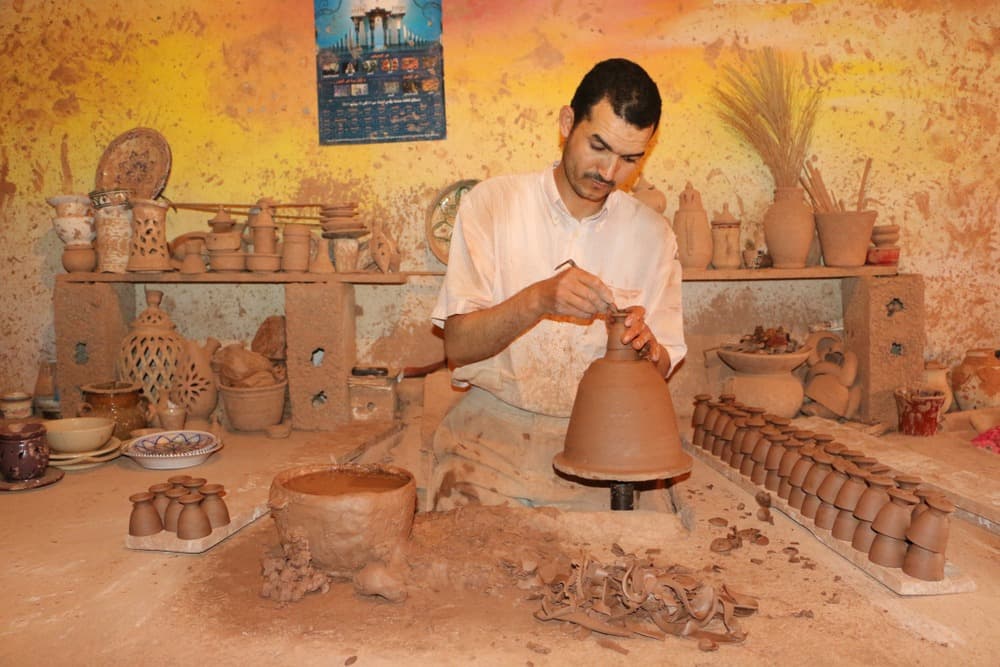
The subtle work of clay also allows for the creation of beautiful objects. Moroccan pottery is renowned, and sublime pieces can be found in Fès, Salé, and Safi, the kingdom's three main production centers. Decorated plates, tajine dishes, vases, ashtrays, plates, lamp bases—all pottery is inspired by Berber traditions, either undecorated or more traditional in style. There are also ceramics known as "urban ceramics," generally decorated with tar-based designs.
While landscapes and scenes of Moroccan life have inspired many Western painters, such as Delacroix and Matisse, pictorial art has developed only recently. Great Moroccan painters like Ahmed Cherkaoui, Bellamine, and Kacimi helped, from the 1950s–60s onward, to establish a modern painting movement. Today, Maroc has its own School of Fine Arts, and fine works can be admired in numerous art galleries, particularly in El Jadida, Rabat, Essouira, Tétouan, and in the heart of Marrakech. Here, the sole gallery of La Qoubba showcases permanent displays from more than twenty artists.
